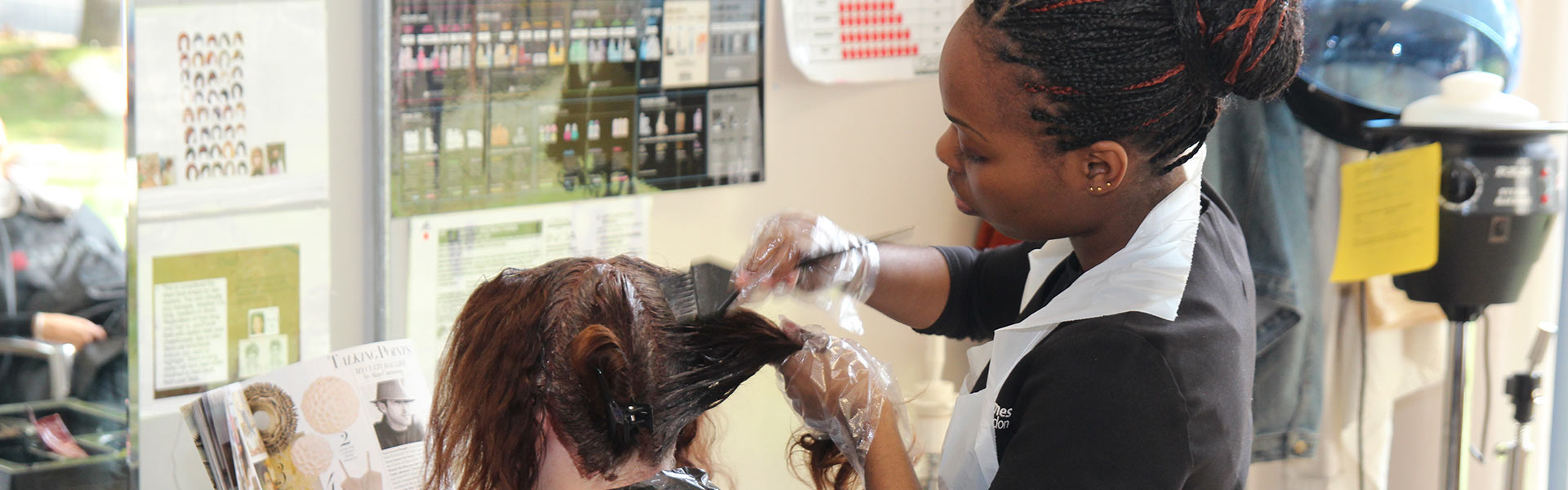
This course covers all aspects of European ladies' hairdressing, learning practical skills in our professional salons enhanced by theoretical knowledge. You will learn how to shampoo and condition the hair and scalp, style hair using drying and setting techniques, cut, perm, neutralise and change hair colour using basic techniques and you will have L'Oreal training days in colouring and perming. You can take part in competitions and visit trade fairs. We recommend you have salon experience whilst studying.
This course is primarily aimed at 16-18 year olds.
-
About the Course
The teaching classes include:
- Practical workshops and theory
- Portfolio assignments
- Special features - trips, exhibitions, competitions (internal and external)
- Work placement/experience
- Assessment feedback on your programme.
You will study:
- Health and safety in the salon
- Client consultation for hair services
- Shampoo and condition hair and scalp
- Promote products and services to clients in a salon
- Cut women's hair
- Cut men's hair
- The art of dressing hair
- Colour and lighten hair
- Perm and neutralise hair
- Create an image based on a theme within the hair and beauty sector.
You will also attend functional skills classes in English and Maths if you have not achieved grade C at GCSE.
-
Additional Costs
Additional Fees
-
Entry Requirements
Applicants for level 2 - intermediate courses should have at least two GCSEs at grade 3 or above or equivalent and/or a pass in a relevant Level 1 qualification, or relevant experience for mature applicants.
Next move - Progress onto a relevant level 3 advanced course or onto an Apprenticeship or into employment.
-
Progression
Level 3 Apprenticeship in Hairdressing (with more work experience), part-time hairdressing or beauty therapy courses and/or work as a junior stylist.
-
Assessment Method
Assessment is continuous throughout the course. You will develop a portfolio of evidence which includes documentation of competence from observations; oral questioning, assignments and written tests. There are four areas of assessment:
- Practical: you carry out the skill
- Oral: you answer questions on your underpinning knowledge of the skill
- Written: a portfolio of evidence or a written test or an assignment, depending on the unit.
- Online tests.